
Summary
Partial blindness affects millions of people worldwide and often limits independence, confidence, and quality of life.
While medical treatments aim to slow or stabilize vision loss, many individuals are left searching for practical ways to function day to day.
This is where AI glasses for low vision are changing the conversation.
AI powered electronic glasses for low vision do not claim to cure eye disease.
Instead, they restore functional vision by enhancing how users interact with their environment. From reading and watching television to navigating unfamiliar spaces, these devices help people with partial blindness regain control over everyday activities.
This article explores how AI glasses work, who they help most, and why they represent a major shift in low vision rehabilitation.
It also explains how functional vision can be restored even when clinical vision cannot.
Understanding Partial Blindness
Partial blindness is not total loss of sight. It refers to significant visual impairment that cannot be corrected with standard glasses, contact lenses, or surgery alone.
People with partial blindness may still perceive light, shapes, movement, or color, but struggle with clarity, contrast, or field of view.
Common causes of partial blindness include macular degeneration, glaucoma, diabetic retinopathy, retinitis pigmentosa, stroke related vision loss, and traumatic brain injury.
Each condition affects vision differently, but the outcome is often the same: difficulty performing everyday tasks that once felt effortless.
Reading mail, recognizing faces, watching television, or safely moving through a room can become frustrating or impossible without assistance.
This is where restoring functional vision becomes critical.
What Is Functional Vision and Why It Matters
Functional vision refers to how well a person uses their remaining eyesight in real life situations. It is different from clinical vision measured on an eye chart.
Someone may have poor visual acuity on paper but still perform well with the right tools and support.
AI glasses for low vision focus on maximizing usable vision rather than repairing damaged eye cells.
This shift from medical correction to functional enhancement is why these devices are so impactful for people with partial blindness.
Restoring functional vision means enabling people to:
- Read printed text
- Watch television or digital screens
- Recognize faces and expressions
- Navigate safely indoors and outdoors
- Maintain independence in daily routines
The Limitations of Traditional Vision Correction
Traditional solutions such as prescription glasses or contact lenses are designed for refractive errors like nearsightedness or farsightedness.
They are not effective for vision loss caused by retinal damage or optic nerve disease.
For many users, switching between multiple devices throughout the day becomes exhausting. This gap in usability is where electronic glasses for low vision powered by AI stand apart.
Other low vision aids like handheld magnifiers, desktop CCTVs, or telescopic glasses provide help in specific situations, but they come with limitations:
- They often require fixed positioning
- They can be bulky or socially awkward
- They do not adapt dynamically to different environments
- They separate the user from natural movement
What Are AI Glasses for Low Vision
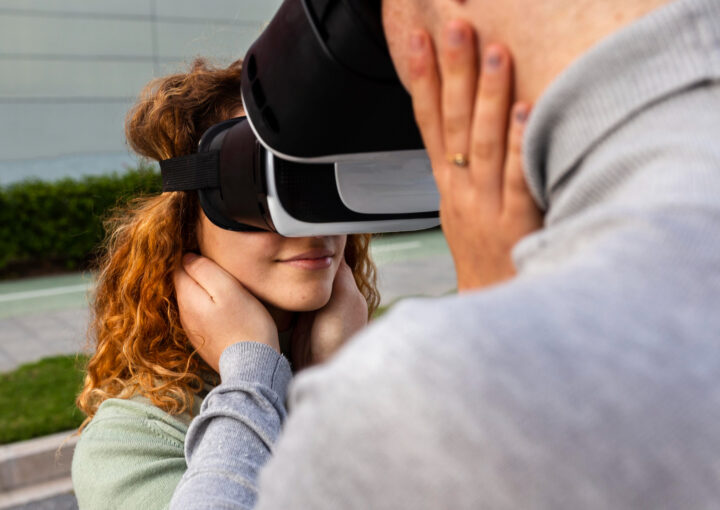
AI glasses for low vision are wearable electronic devices that use cameras, processors, and artificial intelligence software to enhance visual input in real time.
These glasses capture the surrounding environment and display it in a way that aligns with the user’s remaining vision.
Unlike traditional magnifiers, AI glasses adapt dynamically.
They can adjust magnification, contrast, brightness, and field of view instantly. Some models also recognize text, objects, or faces and enhance them visually or audibly.
The goal is not to replace eyesight but to translate visual information into a form the brain can better understand.
This makes AI glasses a powerful tool for restoring functional vision in people with partial blindness.
How AI Technology Enhances Functional Vision
Artificial intelligence plays a central role in how these devices work. AI algorithms analyze visual scenes and optimize them based on the user’s needs.
By continuously processing visual data, AI glasses for low vision respond instantly as the user moves or shifts focus. This creates a more natural and immersive experience than static optical aids.
Some key ways AI improves functional vision include:
- Intelligent magnification that focuses on relevant objects
- Contrast enhancement that highlights edges and shapes
- Image stabilization for users with tremors or nystagmus
- Scene simplification to reduce visual clutter
Key Features That Make AI Glasses Effective
While features vary by device, most electronic glasses for low vision include several core capabilities:
Real Time Magnification
Users can zoom in or out smoothly without losing context. This is essential for reading, television viewing, and recognizing faces.
Adjustable Contrast and Color Modes
High contrast modes help users with macular degeneration or diabetic retinopathy see text and objects more clearly.
Distance and Near Vision Support
AI glasses can switch seamlessly between reading a book and watching TV, eliminating the need for multiple devices.
Hands Free Operation
Wearable design allows users to move naturally without holding a magnifier or sitting at a desk.
These features combine to restore functional vision in ways that feel intuitive and empowering.
How AI Glasses Support Daily Activities
One of the strongest benefits of AI glasses for low vision is their impact on daily life. People with partial blindness often describe a return to activities they had slowly abandoned.
Because these glasses adapt in real time, users experience less eye strain and fatigue. This makes it easier to stay engaged for longer periods.
Common tasks supported by AI glasses include:
- Reading mail, labels, and books
- Watching television and movies
- Using computers, tablets, and smartphones
- Cooking and managing household tasks
- Shopping and recognizing products
- Navigating unfamiliar environments
AI Glasses vs Traditional Low Vision Aids
For people with partial blindness, this shift means fewer compromises and greater freedom throughout the day.
The difference between AI glasses and traditional low vision aids becomes clear when comparing usability and flexibility.
Feature | Traditional Low Vision Aids | AI Glasses for Low Vision |
Portability | Often stationary or handheld | Fully wearable |
Adaptability | Fixed magnification | Dynamic AI driven |
Distance Viewing | Limited | Fully supported |
Ease of Use | Task specific | Multi purpose |
Independence | Partial | High |
Who Benefits Most From AI Glasses
AI glasses for low vision are especially helpful for individuals who still have some usable vision but struggle with clarity or detail.
They are less suitable for individuals with no light perception, as these devices rely on residual vision to be effective.
They are commonly used by people with:
- Macular degeneration
- Glaucoma with remaining central vision
- Diabetic retinopathy
- Retinitis pigmentosa
- Stroke related visual field loss
Real World Impact on Independence and Confidence
The emotional impact of vision loss is often underestimated. Losing the ability to read, watch television, or recognize faces can lead to isolation and depression.
Restoring functional vision through electronic glasses for low vision helps users rebuild confidence.
Many report feeling more independent, socially engaged, and motivated to participate in activities again.
Caregivers also benefit, as users rely less on constant assistance for simple tasks.
Vision Buddy and the Role of AI Glasses
Vision Buddy is an example of how AI glasses for low vision are being used to restore functional vision in practical ways. Designed for people with partial blindness, Vision Buddy enhances both near and distance vision using advanced digital processing.
Rather than focusing on one task, Vision Buddy supports reading, television viewing, computer use, and daily activities within a single wearable system.
This aligns with the real needs of people living with vision loss.
By prioritizing functional vision, Vision Buddy helps users engage with life rather than adapt around limitations.
Choosing the Right AI Glasses for Partial Blindness
Selecting the right device depends on several factors:
- Type and severity of vision loss
- Daily activities that matter most
- Comfort and wearability
- Battery life and ease of control
A low vision specialist can help assess whether AI glasses for low vision are appropriate and which features will offer the most benefit.
Trying a device in real world settings is often the best way to determine suitability.
Future of AI in Vision Rehabilitation
The future of AI glasses is closely tied to advances in artificial intelligence, computer vision, and wearable hardware.
As technology evolves, electronic glasses for low vision will continue to close the gap between visual impairment and full participation in everyday life.
Upcoming developments may include:
- Smarter object recognition
- Improved depth perception support
- Personalized visual profiles
- Integration with smart home systems
Partial blindness does not have to mean losing independence or connection to the world. While medical science continues to explore ways to reverse vision loss, AI glasses for low vision are already restoring functional vision today.
By enhancing usable sight rather than replacing it, these devices empower people to read, watch, navigate, and live with confidence.
For anyone living with partial blindness, electronic glasses for low vision represent a meaningful step forward.
If you or a loved one is exploring options to improve daily vision, learning more about AI powered solutions like Vision Buddy can be an important next step.