

Summary
If you’re researching low vision devices, chances are you’ve already found a few channels testing gadgets on camera, and you’re looking for more. This list rounds up seven low vision creators worth following in 2026, organized by what they’re actually good for: hands-on assistive tech reviews, everyday independent living tips, and channels that tackle vision loss with humor instead of just information. Whichever mix fits what you’re looking for, the goal here is the same one behind any good pre-purchase research: hearing from people who actually live with low vision before you spend real money on a device.
Why Creators Matter More Than a Spec Sheet
A product page can tell you a device’s field of view, battery life, and price. It can’t tell you how that device actually feels to wear for three hours, how it handles a dim restaurant, or whether the voice commands are genuinely intuitive or just marketed that way. That gap is exactly what low vision creators fill. They test devices in real rooms, with real lighting, and they’re not paid to only say nice things.
A lot of people land on this topic after finding a single well-known channel testing low vision tech and wanting more like it. The creators below cover that same ground (and a few adjacent ones), organized into three groups so you can jump to whichever kind of content is most useful to you right now.
Assistive Tech and Gadget Reviewers
These are the channels closest to pure device testing, the ones to watch if you’re comparing specific products before you buy.
1. Double Tap
Hosted by Steven Scott and Shaun Preece, Double Tap is a daily technology show built specifically for a blind and partially sighted audience. They cover a genuinely wide range: smart home tech, smartphones, screen readers, and accessible gaming setups, tested and discussed by hosts who use this technology themselves every day. If you want ongoing, regularly-updated coverage rather than a single review video, this is the one to subscribe to.
Best for: ongoing coverage of new accessible tech as it releases, not just one-off device reviews.
2. James Rath
James Rath is a filmmaker and accessibility activist living with ocular albinism and nystagmus, and his channel has a distinctly cinematic style compared to most tech review content. His focus leans heavily on how mainstream consumer technology, Apple products in particular, can be set up and optimized for low vision use, which makes him a great watch if you’re trying to get more out of the devices you already own before adding a new one.
Best for: getting more accessibility mileage out of mainstream tech you already have.
Read more about James Rath’s work (Wired) →
3. The Tech Doctor Podcast (Robert Carter)
For a deeper dive into accessibility software specifically, The Tech Doctor Podcast is worth searching out on your podcast platform of choice. Robert Carter’s content focuses on meticulous, step-by-step walkthroughs of software accessibility, particularly within the Apple ecosystem, covering VoiceOver and screen magnification in the kind of detail a general tech review usually skips.
Best for: methodical, software-focused walkthroughs of VoiceOver and screen magnification.
Lifestyle and Independent Living Creators
These channels go beyond product reviews into how daily life actually works with low vision or blindness, which is often exactly what you need if you’re evaluating a device for its real-world fit, not just its specs.
4. Molly Burke
Molly Burke is one of the most widely-followed blind creators online, and while a lot of her content is fun, mainstream lifestyle and fashion, she regularly covers independent living skills, travel, and working with her guide dog. Her audience is broad, which makes her content a useful window into how vision loss fits into an otherwise completely normal, active life.
Best for: seeing independent living and daily confidence modeled, not just discussed.
Read more about Molly Burke’s channel (Wired) →
5. Lucy Edwards
Lucy Edwards is best known for her “How does a blind person…” series, which walks through practical daily tasks like applying makeup without sight, cooking, organizing a home, and navigating public spaces. It’s a genuinely useful format if you or a family member is looking for real, demonstrated answers to the “how do you actually do that” questions that come up constantly after vision loss.
Best for: concrete, demonstrated answers to specific daily-living questions.
6. Joy Ross
Joy Ross is a blind mother whose channel shares uplifting, practical advice on household tasks, cooking, parenting, and navigating the world with a guide dog. Her content is especially useful for anyone balancing low vision with the daily logistics of running a household or raising a family, an angle that doesn’t come up as often in gadget-focused channels.
Best for: parents and caregivers looking for household and family-life perspective.
Humor and Mindset
7. The Tommy Edison Experience
Blind from birth, Tommy Edison built his channel around humor and candor, answering the public’s most common (and sometimes wonderfully unusual) questions about blindness. If you’re newer to this community, or supporting someone who is, it’s a genuinely good entry point: educational without ever feeling heavy, and a good reminder that vision loss doesn’t have to be the only lens a person is seen through.
Best for: a lighter, more positive on-ramp for anyone new to low vision content.
Watch The Tommy Edison Experience on YouTube →
Quick Reference: Who to Watch for What
Creator | Focus Area | Best For |
|---|---|---|
Double Tap | Daily assistive tech news and reviews | Staying current on new accessible devices |
James Rath | Mainstream tech, optimized for low vision | Getting more out of devices you already own |
The Tech Doctor Podcast | Apple accessibility software deep-dives | VoiceOver and screen magnification detail |
Molly Burke | Lifestyle, fashion, independent living | Seeing an active daily life with vision loss |
Lucy Edwards | Practical daily task walkthroughs | Concrete answers to “how do you actually do that” |
Joy Ross | Parenting and household life | Caregivers and parents navigating low vision |
The Tommy Edison Experience | Humor and mindset | A lighter, welcoming entry point |
How to Actually Use These Channels When Researching a Device
Watching reviews is a great first step, but it’s easy to end up with ten open tabs and no clearer decision than when you started. A few ways to get more out of the time:
- Watch for the moments they don’t script. The most useful part of a device review is rarely the intro, it’s the ten seconds where the creator fumbles with a menu or squints at a screen in bad lighting. That’s the real usability data.
- Compare their daily routine to yours. A reviewer who mostly tests devices outdoors and on the move will surface different pros and cons than one who mostly evaluates them at a desk or in front of a TV. Weight their take accordingly.
- Look for repeat mentions, not just one glowing video. A device that keeps coming up positively across several unrelated creators is a stronger signal than a single sponsored-feeling review.
- Use videos to narrow your list, not to make the final call. A video, however honest, is still someone else’s lighting, someone else’s eyes, and someone else’s home. The only way to know how a device performs in yours is to actually try it there.
That last point is really the whole reason in-home trials exist. No video, including the ones linked above, can tell you how a device performs on your own couch, under your own kitchen lighting, with your own daily routine. That’s what a real trial period is for.
Frequently Asked Questions
Who are the best low vision YouTubers to follow in 2026?
It depends on what you’re looking for. For device-focused content, Double Tap, James Rath, and The Tech Doctor Podcast are strong picks. For daily living and lifestyle content, Molly Burke, Lucy Edwards, and Joy Ross are well worth following. The Tommy Edison Experience is a great, lighter entry point into the community as a whole.
Where can I find honest low vision device reviews?
Creator channels like the ones above are a good starting point because the hosts generally use this technology themselves and aren’t shy about pointing out limitations. That said, no video review replaces trying a device yourself, in your own home, under your own conditions.
Are low vision device reviews on YouTube trustworthy?
Many are, especially from creators who are themselves blind or low vision and testing devices in their actual daily life rather than in a studio demo. As with any review content, it’s worth watching a few different creators on the same device to see whether their impressions line up, and treating any single video as one data point rather than the final word.
Does Vision Buddy have real, non-sponsored user feedback available too?
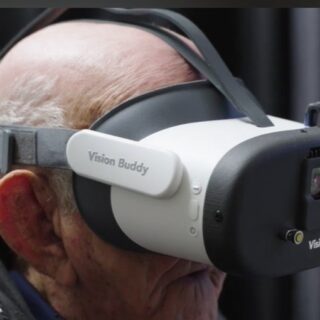
Vision Buddy offers a 14-day in-home trial for $100 plus a refundable $1,000 security deposit specifically so you’re not relying on anyone else’s review, including ours, to make the decision. It’s the same principle behind this whole list: real use, in a real home, tells you more than any video can.
What to Do Next
Use the creators above to narrow down what actually matters to you in a low vision device, whether that’s TV viewing, reading, face recognition, or something else entirely. Then take the one step none of them can do for you: try the device yourself, in your own home, before you commit.