

Summary
Telehealth and telemedicine are two of the most commonly confused terms in modern healthcare, often used interchangeably even though they refer to meaningfully different things.
Understanding the distinction matters for patients navigating insurance coverage, for healthcare organizations managing compliance, and for anyone trying to make sense of what services are actually available to them.
This blog breaks down the telehealth vs telemedicine difference in plain language, with real-world examples, and explains why this distinction is particularly relevant for people managing eye conditions and low vision who rely on remote healthcare access.
Why This Distinction Confuses So Many People
Part of the confusion stems from the fact that there is no single, universally agreed-upon definition for either telehealth or telemedicine, with different organizations and regulatory bodies using the terms in slightly different ways.
Both terms became significantly more visible during the COVID-19 pandemic, when remote healthcare delivery rapidly expanded out of necessity, and in casual usage they often got flattened into meaning the same thing: seeing a doctor on a video call.
In practice, the two terms describe a relationship of scope rather than two entirely separate categories.
One is a broad umbrella, and the other is a specific category that sits underneath it.
Getting this relationship clear helps make sense of how each term gets used in different contexts.
Defining Telehealth: The Umbrella Term
The Department of Health and Human Services’ Health Resources and Services Administration defines telehealth as the use of electronic information and telecommunications technologies to support and promote long-distance clinical health care, patient and professional health-related education, public health, and health administration.
Telehealth is best understood as a broad umbrella term that encompasses all uses of technology to support and deliver healthcare-related services, both clinical and non-clinical.
This includes telemedicine itself, but also extends well beyond it to remote patient monitoring, patient education platforms, provider training programs, administrative healthcare services, and mobile health applications.
Telehealth covers remote services that go beyond simple patient-physician interaction, including things like medical training programs, virtual clinical staff meetings, and general health check-ups conducted through mobile apps that may not involve a licensed clinician making a diagnosis at all.
Defining Telemedicine: The Clinical Subset
Telemedicine is a subset of telehealth that focuses solely on direct clinical encounters, specifically situations where a physician diagnoses, treats, and prescribes care through secure video, phone, or messaging technology.
Telemedicine refers specifically to the remote delivery of clinical medical services by licensed physicians and other medical practitioners, functioning as the digital equivalent of an in-office medical visit focused narrowly on diagnosis, treatment, and prescription.
Telemedicine can occur in real time, which is commonly used for urgent care, primary care, and chronic illness follow-up, or through a store-and-forward approach, sometimes called asynchronous telemedicine, where a provider shares medical information for later review rather than conducting a live interaction.
Telehealth vs Telemedicine: A Side-by-Side Comparison
Telehealth Scope: Broad umbrella term covering all technology-enabled healthcare services Includes: Clinical care, patient education, provider training, administrative services, remote monitoring, mobile health apps Provider involved: Not always; some telehealth services do not require a licensed clinician Billing: May be reimbursed under remote monitoring or education codes, varying by payer
Telemedicine Scope: Narrow, clinical-only subset of telehealth Includes: Diagnosis, treatment, and prescription delivered remotely by a licensed clinician Provider involved: Always a licensed physician or practitioner Billing: Reimbursed under evaluation and management (E/M) visit codes |
The simplest way to remember the relationship is this: all telemedicine is telehealth, but not all telehealth is telemedicine.
Telemedicine sits entirely within the telehealth category, but telehealth extends to many services that fall outside what telemedicine covers.
Real-World Examples of Each
A patient who schedules a virtual consultation with a dermatologist for a skin rash, has the condition diagnosed over video, and receives a prescription is participating in telemedicine, a clear clinical encounter conducted remotely.
A diabetes management program that uses remote monitoring devices to send patient data to nurses who adjust care plans accordingly, combined with educational webinars that reinforce self-management skills, illustrates telehealth that extends beyond direct physician visits into broader patient support.
A hospital system that uses a patient portal to deliver post-discharge educational materials is using telehealth, even though no live clinical interaction with a physician occurs through that specific service.
Similarly, a wearable device that continuously transmits blood glucose data to a care team dashboard for monitoring purposes is a telehealth application, distinct from the clinical telemedicine visits that might be triggered by concerning readings in that data.
For eye care specifically, a patient having a video consultation with their ophthalmologist to discuss symptoms, review test results, and receive treatment recommendations is engaging in telemedicine.
A low vision rehabilitation program that provides remote training videos, educational materials about assistive technology, and asynchronous check-ins with a vision rehabilitation specialist represents the broader telehealth category.
Why the Difference Matters for Billing and Insurance
The telehealth vs telemedicine distinction has direct, practical consequences for how healthcare services get billed and reimbursed.
Telehealth services may be reimbursed under remote monitoring or education billing codes, while telemedicine is reimbursed under evaluation and management visit codes, with clinics needing to ensure proper documentation and patient consent to avoid claim denials.
Telemedicine is governed primarily by state medical licensing boards, the Drug Enforcement Administration for controlled substance prescribing, and Centers for Medicare and Medicaid Services reimbursement rules, reflecting its status as direct clinical care subject to the same regulatory framework as in-person medical practice.
For patients, understanding this distinction helps set accurate expectations about what insurance is likely to cover and what documentation might be required.
A telemedicine visit with a physician typically follows similar coverage rules to an in-person visit, while broader telehealth services like health education apps or remote monitoring programs may be covered differently or require separate authorization.
Why the Difference Matters for Patients
Patient expectations are shaped significantly by which type of service they are engaging with.
When someone signs up for a telemedicine appointment, they reasonably expect a licensed clinician to evaluate their condition, provide a diagnosis, and prescribe treatment if appropriate.
In contrast, broader telehealth encounters, like wellness coaching sessions, chronic disease education programs, or remote monitoring check-ins, serve a different purpose and typically do not result in a formal diagnosis or prescription, even though they remain a valuable part of comprehensive care.
Knowing which type of service you are using helps you ask the right questions before an appointment, understand what outcomes to expect, and recognize when you may need to escalate to a formal telemedicine visit with a licensed provider rather than relying on a broader telehealth tool or app for something that requires an actual diagnosis.
How Both Apply to Eye Care and Low Vision Patients
Both telehealth and telemedicine have become increasingly important in eye care and low vision rehabilitation specifically.
Telemedicine applications in ophthalmology include virtual consultations for non-urgent eye concerns, follow-up visits after procedures, and medication management for conditions like glaucoma that require ongoing monitoring and adjustment.
Telehealth, in the broader sense, has expanded significantly in low vision rehabilitation.
The VA, for example, now offers Blind Telerehabilitation services, giving veterans with vision loss access to virtual rehabilitation and training programs that extend the reach of specialized low vision services to veterans who face transportation barriers, mobility impairments, or live in remote locations far from a Blind Rehabilitation Center.
This expansion of telehealth into low vision rehabilitation specifically reflects the same access benefits seen across geriatric telehealth more broadly, extending specialized services to populations who would otherwise face significant barriers to receiving them in person.
The Role of Assistive Technology in Making Both Accessible
Whether someone is using telemedicine for a direct clinical consultation or broader telehealth tools for education and monitoring, the ability to actually see and engage with the screen-based interface is fundamental to the experience working as intended.
For patients with low vision conditions, this creates a meaningful accessibility gap that intersects directly with the telehealth and telemedicine conversation.
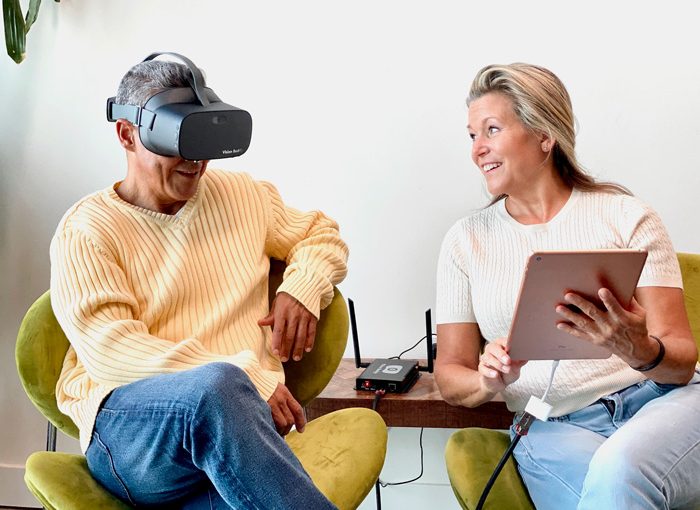
Vision Buddy’s Computer Link feature, which displays computer and tablet screens in magnified, enhanced form through the headset, allows users with significant vision impairment to participate fully in both telemedicine consultations and broader telehealth services, seeing their provider clearly, reading on-screen information, and navigating digital health platforms independently.
This is particularly relevant given that many of the patients who rely most heavily on telehealth and telemedicine, including older adults managing chronic conditions and people with progressive eye diseases like macular degeneration and diabetic retinopathy, are also the patients most likely to be managing low vision that could otherwise prevent them from accessing these remote services effectively.
Final Thoughts
The telehealth vs telemedicine distinction is not just semantic.
It shapes billing, regulation, patient expectations, and the practical scope of what each type of service can offer.
Telehealth is the broad umbrella covering every use of technology to support healthcare delivery, education, and administration.
Telemedicine is the specific, clinical subset focused on direct diagnosis and treatment by a licensed provider.
As both categories continue to expand in 2026, particularly for populations like geriatric patients and people managing chronic eye conditions, ensuring genuine accessibility, including visual accessibility for patients with low vision, is an essential part of making sure these technologies actually reach and benefit the people who need them most.
Tools like Vision Buddy that bridge the gap between vision loss and digital healthcare access play an important role in making the full promise of telehealth and telemedicine a reality for everyone, not just those with unimpaired vision.