

Summary
Macular degeneration remains the leading cause of severe vision loss in adults over 60 in the developed world, but the treatment landscape has changed dramatically over the past two decades, and it continues to evolve quickly.
This blog walks through the best treatment for macular degeneration available today, covering current standard-of-care injections, what is coming through gene therapy trials, the nutritional approach backed by major research, and the equally important question of what to do about the vision that medical treatment cannot restore.
Because medical treatment slows or stabilizes macular degeneration, it does not give most people their old vision back, and that is exactly where modern low vision technology like Vision Buddy plays a critical role in a complete treatment plan.
Understanding Wet and Dry Macular Degeneration
Age-related macular degeneration (AMD) affects the macula, the part of the retina responsible for sharp, central vision.
There are two forms, and the treatment approach for each is different.
Dry AMD is the more common form, accounting for about 80 to 90 percent of cases.
It develops as the macula thins with age and small deposits called drusen accumulate beneath the retina.
Dry AMD progresses slowly in most people, though it can advance to a more severe stage called geographic atrophy, where patches of retinal tissue die off completely, causing more significant central vision loss.
Wet AMD is less common but more aggressive.
It occurs when abnormal blood vessels grow underneath the retina and leak fluid or blood, causing rapid and often severe damage to central vision if untreated.
Wet AMD is responsible for the majority of severe vision loss associated with AMD despite being the less common form, precisely because of how quickly it can progress.
Both forms are progressive and currently incurable, though treatment options exist for slowing progression and, in the case of wet AMD, often preventing further vision loss.
Understanding which form you have, and how advanced it is, is the starting point for determining the best treatment for macular degeneration in your specific situation.
Current Standard Treatment: Anti-VEGF Injections
For wet AMD, anti-VEGF (vascular endothelial growth factor) injections have been the gold standard treatment for over a decade, and for good reason.
These medications, including bevacizumab, ranibizumab, and aflibercept, work by blocking VEGF, the protein responsible for triggering the abnormal blood vessel growth that characterizes wet AMD.
The treatment involves injecting the medication directly into the vitreous gel of the eye, typically performed in an ophthalmologist’s office.
While the idea of an eye injection understandably makes many patients anxious, the procedure itself is brief and the eye is numbed beforehand.
For most patients, anti-VEGF treatment prevents further vision loss and a meaningful proportion experience some improvement in visual acuity.
The challenge with anti-VEGF treatment has historically been the frequency of injections required.
Many patients needed injections every four to eight weeks indefinitely to maintain the treatment benefit, which creates a substantial burden in terms of appointments, cost, and the physical and emotional toll of repeated eye injections, particularly for older patients who may have mobility challenges or rely on others for transportation.
Faricimab and the Move Toward Longer-Lasting Treatments
One of the most significant recent developments in AMD treatment is faricimab, marketed as Vabysmo.
Faricimab represents an evolution beyond standard anti-VEGF therapy because it targets two pathways simultaneously: VEGF and a protein called angiopoietin-2, which is also involved in the abnormal blood vessel changes seen in AMD.
The dual-action mechanism allows for longer intervals between treatments.
Research suggests most patients receiving faricimab can extend the interval between treatments to three to four months rather than the monthly or bimonthly schedule required by earlier anti-VEGF drugs.
This is a meaningful quality-of-life improvement for patients managing the practical burden of ongoing eye injections.
Tyrosine kinase inhibitors are another area of active development for extending treatment intervals further.
While not yet FDA approved, these medications are being studied for their potential to allow some patients to go as long as six months between treatments.
If these prove safe and effective in ongoing trials, they could meaningfully reduce the treatment burden for wet AMD patients in the coming years.
Treatment for Dry AMD and Geographic Atrophy
Treatment options for dry AMD, particularly the advanced geographic atrophy stage, have historically lagged behind wet AMD treatment, but this is an area of intense current research with several promising approaches in late-stage trials.
Complement inhibitor therapies, which target part of the immune system implicated in the progression of geographic atrophy, have received regulatory attention as the first treatments specifically aimed at slowing dry AMD progression.
These represent an important milestone because, unlike anti-VEGF drugs that address wet AMD’s vascular component, complement inhibitors target the inflammatory and immune mechanisms believed to drive geographic atrophy.
Several other approaches are in active clinical development.
Elamipretide, a once-daily self-administered subcutaneous injection, works by stabilizing mitochondria within retinal cells to reduce the cellular stress associated with geographic atrophy progression, and showed meaningful vision protection benefits in Phase 2 trials.
Other gene therapy candidates, such as OCU-410, have shown encouraging early results, with one Phase 1/2 trial reporting a 46 percent reduction in the growth rate of atrophic lesions.
For most patients currently managing dry AMD that has not progressed to geographic atrophy, regular monitoring and nutritional intervention remain the primary management approach, alongside close attention to modifiable risk factors like smoking and blood pressure control.
Gene Therapy: The Most Promising Frontier
Gene therapy represents what many retina specialists consider the most exciting direction for AMD treatment, with the potential to fundamentally change how the disease is managed.
The concept behind gene therapy for wet AMD is to turn the eye into its own factory for producing anti-VEGF medication, eliminating or dramatically reducing the need for repeated injections.
The most advanced gene therapy candidate currently in development, ABBV-RGX-314, delivers a gene that produces a VEGF-blocking protein, and in early trials it stabilized or improved visual acuity in wet AMD patients over two years, with most participants needing no additional injections during that period.
Two Phase III clinical trials for this gene therapy, named ATMOSPHERE and ASCENT, are expected to report results in 2026, which will be a significant milestone for the field if the results confirm the earlier safety and efficacy findings.
Multiple delivery methods are being studied, including subretinal injection (which requires a surgical procedure) and suprachoroidal delivery (a less invasive injection approach), each with different risk and convenience profiles.
For dry AMD, gene therapy approaches targeting different biological pathways are also progressing through trials, offering hope for a one-time or infrequent treatment that could meaningfully slow disease progression rather than requiring ongoing management.
Nutritional Treatment: The AREDS2 Formula
One of the most well-established and accessible interventions for AMD is nutritional supplementation, based on the landmark Age-Related Eye Disease Study and its follow-up, AREDS2, funded by the National Eye Institute.
The AREDS2 formula includes vitamin C, vitamin E, lutein, zeaxanthin, zinc, and copper, and has been shown in large clinical trials to reduce the risk of progression to advanced AMD by about 25 percent in people with intermediate AMD or advanced AMD in one eye.
This is not a treatment for early AMD, and it does not reverse existing damage, but it represents a meaningful, low-risk intervention for slowing progression in people at the right stage of the disease.
It is worth noting that the AREDS2 formula is specifically beneficial for people with intermediate or advanced AMD.
People with early-stage AMD or no AMD have not shown the same benefit from supplementation in clinical trials, and unnecessary supplementation, particularly with high-dose zinc, carries its own risks.
A conversation with your ophthalmologist about whether and which formula is appropriate for your specific stage of disease is an important part of any treatment plan.
Lifestyle Factors That Support Treatment
Medical treatment for AMD works best alongside lifestyle factors that are within a patient’s control and that influence disease progression.
Smoking cessation:
Smoking is one of the strongest modifiable risk factors for AMD progression. Quitting smoking at any stage of the disease reduces the risk of further progression.
Cardiovascular health:
Managing blood pressure, cholesterol, and overall cardiovascular health supports retinal blood flow and may slow AMD progression, given the vascular components of the disease.
Diet rich in leafy greens:
A diet high in lutein and zeaxanthin from sources like spinach and kale, along with omega-3 fatty acids from fish, is associated with reduced AMD risk and progression in observational studies.
UV protection:
Wearing sunglasses that block UV light is a simple, low-cost measure some specialists recommend, though the evidence specifically for AMD prevention is less robust than for other risk factors.
Regular monitoring:
Routine eye exams, including dilated retinal exams and home monitoring with an Amsler grid for early detection of changes, allow earlier intervention when progression occurs.
Why Medical Treatment Is Only Half the Picture
This is the part of the macular degeneration conversation that often gets less attention than it should.
Even the best treatment for macular degeneration, whether anti-VEGF injections, emerging gene therapy, or nutritional support, is generally aimed at slowing progression or stabilizing vision, not restoring the central vision that has already been lost.
For many people living with intermediate to advanced AMD, this means that even with excellent medical management, they are still navigating daily life with significant central vision loss.
Reading, recognizing faces, watching television, and managing fine visual detail remain genuinely difficult, regardless of how well the underlying disease is being medically controlled.
This is precisely the gap that low vision rehabilitation and assistive technology are designed to fill.
Treating the disease and adapting to the vision loss that has already occurred are two different and equally important parts of a complete care plan.
Low Vision Aids as Part of a Complete Treatment Plan
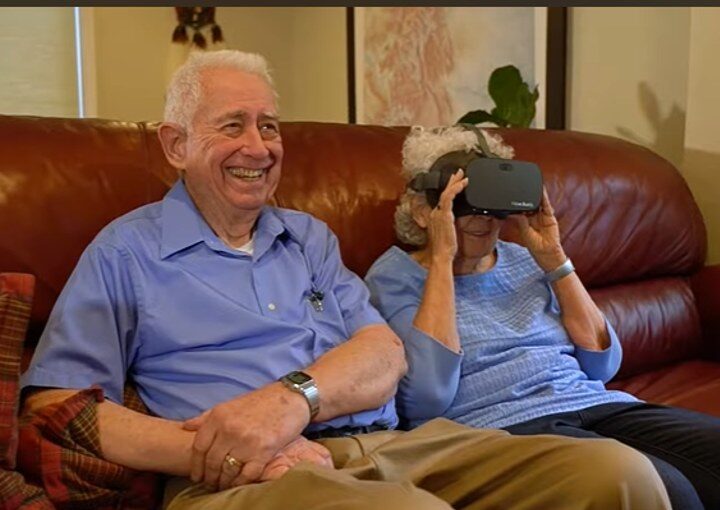
Vision Buddy is specifically designed for the kind of central vision loss that macular degeneration causes.
Rather than attempting to treat the underlying retinal disease, which remains the domain of medical and surgical intervention, Vision Buddy addresses the functional consequence: the inability to see fine detail clearly using natural central vision.
The device works by capturing the visual scene with a high-resolution Sony AI camera and displaying a magnified, contrast-enhanced version on a 4K per-eye display positioned close to the eyes.
For someone with macular degeneration whose central vision is damaged but whose peripheral vision remains relatively intact, this allows the remaining functional retina to be used more effectively, a principle called eccentric viewing that low vision specialists have long recommended.
The dedicated TV Hub system addresses one of the activities most affected by AMD: television watching.
Many people with macular degeneration struggle to follow programming because they cannot resolve detail in faces or on-screen text.
The TV Hub streams television wirelessly to the headset, where it is magnified and enhanced, restoring an activity that medical treatment alone cannot meaningfully improve.
Vision Buddy works with ophthalmologists and optometrists who treat AMD patients as part of their broader care, and has clinical partnerships with institutions including Johns Hopkins and UCLA Stein Eye Institute.
This reflects the recognition within the eye care community that assistive technology is not separate from medical treatment but a complementary part of comprehensive AMD management.
Building Your Best Treatment Plan
The best treatment for macular degeneration is rarely a single intervention. It is a coordinated combination tailored to your specific diagnosis and stage.
- Get a precise diagnosis from a retina specialist, including whether you have wet or dry AMD and what stage your condition is at, since this fundamentally shapes treatment recommendations.
- If you have wet AMD, discuss anti-VEGF treatment options with your specialist, including newer dual-action drugs like faricimab that may reduce your treatment frequency.
- If you have intermediate or advanced dry AMD, ask whether the AREDS2 supplement formula is appropriate for your specific situation.
- Stay informed about clinical trials for gene therapy and complement inhibitors, particularly if you have geographic atrophy, since this field is moving quickly and new options are becoming available.
- Address modifiable risk factors including smoking, blood pressure, and diet, which support whatever medical treatment you are receiving.
- Get a referral to a low vision specialist to address the functional vision loss that medical treatment does not reverse, and explore assistive technology like Vision Buddy that can restore meaningful daily function.
Macular degeneration treatment has improved dramatically over the past twenty years, and the pace of innovation continues to accelerate, with gene therapy and longer-lasting drugs offering real hope for reducing the burden of ongoing treatment.
But treating the disease and living well with the vision loss it has already caused are both essential parts of managing AMD.
If you or someone you love is managing macular degeneration and has been focused entirely on the medical treatment side of the equation, it may be time to also explore what modern low vision technology can do for the daily activities that matter most.
Vision Buddy offers a practical way to restore meaningful independence for watching TV, reading, and managing daily life alongside whatever medical treatment your retina specialist has you on.