Summary
Envision Glasses and Vision Buddy are both AI-powered wearables for people with vision loss, but they’re built around different core use cases. Envision Glasses leans into navigation, scene description, and general independence for a more active, tech-comfortable user. Vision Buddy leans into the specific, everyday moments that come up at home: watching TV, reading mail and medication labels, and recognizing a face across the room. This post breaks down the real differences in price, features, and fit.
The Short Answer
If you’re comparing these two because you’ve seen both mentioned in the same “best AI glasses” roundup, here’s the short version: Envision Glasses is built on the Google Glass hardware platform and is designed for broader daily independence, think navigation, object recognition, and scene description on the go. Vision Buddy is purpose-built around a smaller set of high-frequency home activities, watching television, reading, and recognizing people, done exceptionally well rather than a wide feature list done adequately.
Neither is “better” in the abstract. They’re solving different problems, and the right one depends on which problem you actually have.
What Envision Glasses Actually Is
Envision Glasses pairs Envision’s AI software with Google Glass Enterprise Edition hardware. It’s a lightweight, glasses-style wearable that uses a voice-command interface to read text aloud, describe scenes, recognize faces (with permission), find objects, and help with navigation and color identification. It’s priced at approximately $3,500 and is generally positioned toward users who want a single device to support a wide range of independent daily activities, both indoors and out.
Because it runs on general-purpose smart glasses hardware, it’s compact and can be worn throughout the day. The tradeoff is that it’s built for breadth: doing a lot of things reasonably well, rather than optimizing deeply for any one of them.
What Vision Buddy Actually Is
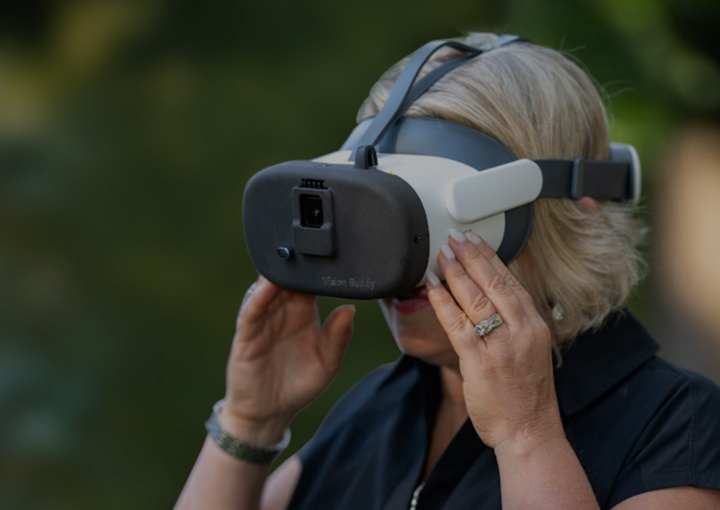
Vision Buddy is an all-in-one wearable device built around three specific, everyday use cases: watching television through wireless streaming directly to the headset, reading via built-in optical character recognition (OCR) for mail, labels, and books, and recognizing people and surroundings through live camera magnification. It requires no formal training to start using, with voice commands handling most core functions.
Vision Buddy’s current lineup runs from $2,995 (VB 4 Viewer, built for reading and computer use at a desk) to $3,995 (VB 4 Max, maximum magnification and full feature set), with the VB Mini at $3,795 for all-day portability. Every device comes with a 14-day, in-home trial for $100 plus a refundable $1,000 security deposit, with setup assistance and tech support included.
Side-by-Side Comparison
Envision Glasses | Vision Buddy | |
Starting price | ~$3,500 | $2,995 to $3,995 |
Core use case | Broad daily independence | Home-focused: TV, reading, faces |
Hardware style | Google Glass-based smart glasses | Purpose-built headset |
Training required | Some learning curve | None, voice commands from day one |
Trial period | Confirm directly with Envision | 14 days in-home, refundable deposit |
Where Envision Glasses Makes Sense
If you already know your biggest frustrations are concentrated in a few specific, high-frequency moments, not being able to watch a show with the family without sitting uncomfortably close to the screen, struggling to read a prescription label, not being able to make out a grandchild’s face across the room, a device built specifically around those moments tends to deliver more depth where it matters.
Where Vision Buddy Makes Sense
If you already know your biggest frustrations are concentrated in a few specific, high-frequency moments, not being able to watch a show with the family without sitting uncomfortably close to the screen, struggling to read a prescription label, not being able to make out a grandchild’s face across the room, a device built specifically around those moments tends to deliver more depth where it matters.
The Question That Matters More Than Either Spec Sheet
Whichever device you’re leaning toward, the single most useful thing you can do before committing real money is ask: does this company let me actually try it at home before I buy it? Vision Buddy’s answer is a 14-day in-home trial for $100 plus a refundable $1,000 security deposit, with support included throughout and a clear refund schedule if it isn’t the right fit. Hold every option to that same standard.
Frequently Asked Questions
Is Envision Glasses or Vision Buddy better for macular degeneration specifically?
Both can help, since both rely on magnification, contrast enhancement, and reading assistance. Vision Buddy’s TV streaming and live magnification are built especially around the moments macular degeneration most commonly affects.
Can I try before I buy with either device?
Vision Buddy offers a 14-day in-home trial for $100 plus a refundable $1,000 security deposit. Confirm Envision’s current trial terms directly with Envision.
Do either of these require a prescription?
No, devices in this category are typically consumer assistive technology rather than prescription medical devices, though it’s worth confirming directly and discussing options with a low vision specialist.
Is one of these cheaper than the other?
Vision Buddy’s entry point (VB 4 Viewer at $2,995) is lower than Envision Glasses’ roughly $3,500 starting price.
For more comparisons like this, see how Vision Buddy stacks up against eSight or against IrisVision, eSight, and OrCam side by side.
What to Do Next
If Vision Buddy’s home-focused feature set sounds like the closer fit, the lowest-risk next step is to fill in the contact us form and let us guide you about the rest.