
Summary
Falls are the leading cause of injury among older adults, and vision plays a much bigger role in preventing them than most people assume.
Every September, Falls Prevention Awareness Week puts a spotlight on a problem that’s genuinely preventable, and vision is one of the most overlooked pieces of that prevention. This guide covers why low vision raises fall risk, the specific ways it shows up in everyday life, and what actually helps, from home changes to the kind of assistive technology that restores enough visual confidence to move through a familiar space safely.
Why Vision and Balance Are More Connected Than Most People Realize
Balance depends on three systems working together: the inner ear, the sense of touch and position in the feet and joints, and vision.
Of the three, vision does an enormous amount of the quiet, moment-to-moment work, spotting a step down before a foot gets there, noticing a rug edge has curled up, judging the distance to a chair before sitting down. When vision is reduced, whether from macular degeneration, glaucoma, diabetic retinopathy, or any of the conditions that cause low vision, the body has to rely more heavily on the other two systems, and neither one is built to fully cover for the loss.
This is why falls and vision loss show up together so often in older adults, even when the vision loss itself doesn’t feel severe day to day.
A person can still be reading, watching television, and getting around the house, while quietly losing the specific kind of depth perception, contrast sensitivity, and peripheral awareness that keeps a stairway or a curb safe.
What the Research Actually Shows
Falls are already common among older adults, more than one in four falls at least once a year, according to the National Council on Aging.
What’s less widely known is how much vision specifically contributes to that number.
Research using long-running national health data has found that people with impaired eyesight have a meaningfully higher risk of falling than people with normal vision, and that the risk increases further when it comes to distance vision, near vision, and something called contrast sensitivity, the ability to tell a step or an edge apart from its surroundings even when the lighting isn’t perfect.
Contrast sensitivity is worth calling out specifically, because it’s often the first thing to go and the last thing anyone notices.
A person can pass a standard eye chart reasonably well and still struggle badly to see a gray step against a gray sidewalk, or a clear glass door against a dim hallway, which is exactly the kind of everyday hazard that leads to a fall.
The Specific Ways Low Vision Leads to Falls
Vision loss doesn’t cause falls in one single way, it creates risk through several everyday moments stacking up:
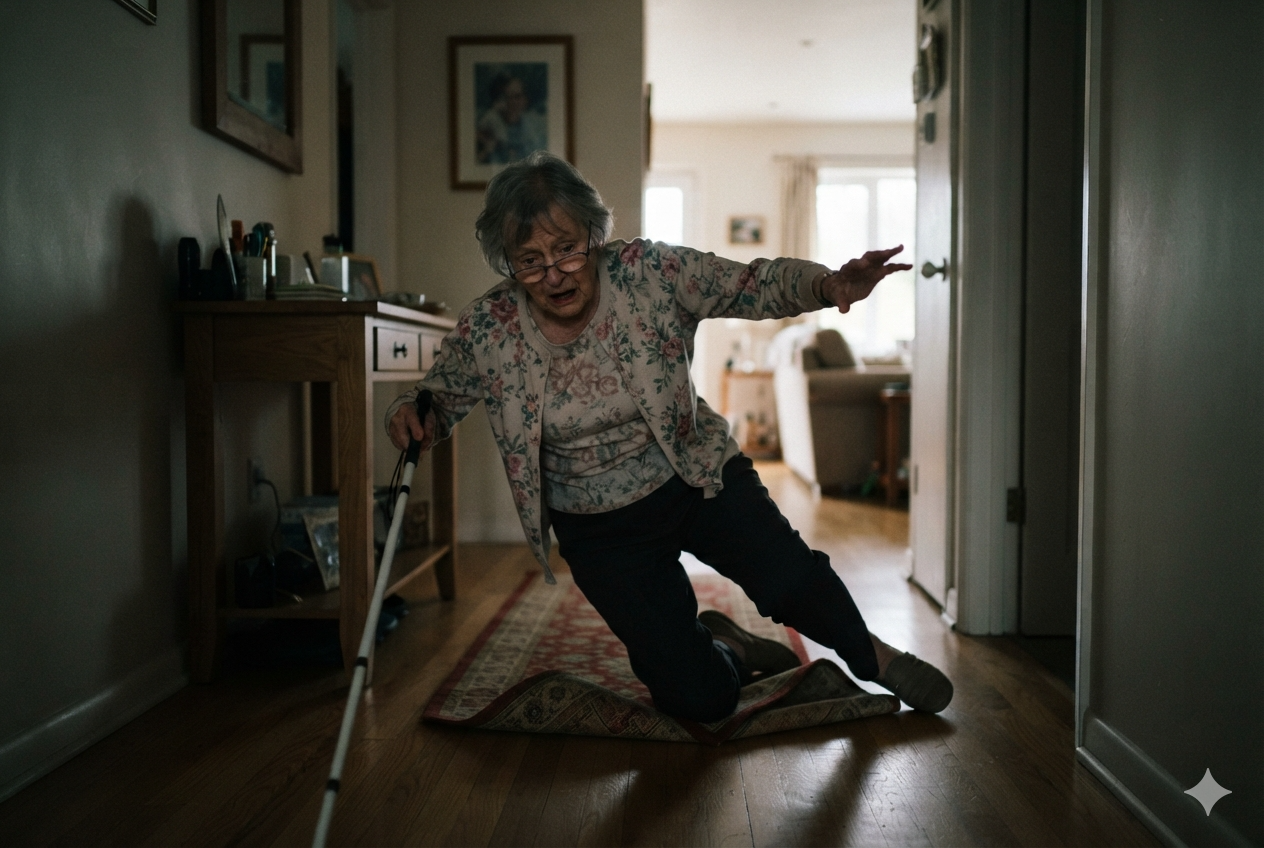
- Missing changes in floor level, like a single step, a curb, or where a rug meets a hard floor
- Misjudging distance, making it harder to know exactly how far away a chair, a step, or a doorway actually is
- Reduced contrast sensitivity, which makes it harder to spot an edge or obstacle that doesn’t have strong color contrast against its background
- Poor lighting adaptation, especially the delay some eye conditions cause when moving from a bright room into a dim one, or vice versa
Narrowed peripheral vision, common in conditions like glaucoma and retinitis pigmentosa, which can mean not seeing an obstacle off to the side until it’s too late to adjust
None of these require severe vision loss to matter. Even moderate, early-stage vision changes can be enough to turn a familiar hallway into a genuine hazard, which is part of why fall risk often rises well before someone would describe themselves as having “bad vision.”
Warning Signs It’s Time to Take a Closer Look
A few patterns are worth paying attention to, whether it’s your own experience or something you’re noticing in a parent or older loved one:
- Holding onto walls, furniture, or a partner’s arm more than before, especially in unfamiliar or dimly lit spaces
- Hesitating or slowing down noticeably at stairs, curbs, or thresholds
- A recent near-miss or an actual fall, even a minor one
- Squinting or struggling more in bright light or when moving between light and dark spaces
- New reluctance to go out at night or in unfamiliar places
Any one of these on its own isn’t necessarily alarming, but a pattern of them is worth a conversation with an eye doctor, and worth thinking seriously about what would help day to day, not just what the eye exam shows on paper.
What Actually Helps Reduce Fall Risk
The most effective approach to fall prevention combines home safety changes with directly addressing the vision loss itself, rather than treating them as separate problems:
- Improve lighting throughout the home, especially stairwells, hallways, and entryways, since brighter, more even lighting reduces the contrast problem significantly
- Add contrast where it matters, like a brightly colored strip on the edge of steps, or a contrasting bath mat against a light-colored floor
- Clear walkways of loose rugs, cords, and clutter, the classic fall-prevention advice, and still genuinely effective
- Install grab bars and handrails in bathrooms and stairways, used consistently rather than just when something feels unsteady
- Get a real, current eye exam, since some causes of vision loss are treatable, and even when they aren’t, an accurate diagnosis changes what kind of help actually makes sense
- Address the vision loss directly, through the right combination of magnification, contrast enhancement, and lighting adaptation, rather than only working around it
That last point is often the piece that gets skipped, home modifications help, but they don’t restore the visual information a person needs to move confidently.
That’s where the right assistive technology comes in.
How Assistive Technology Fits Into Fall Prevention
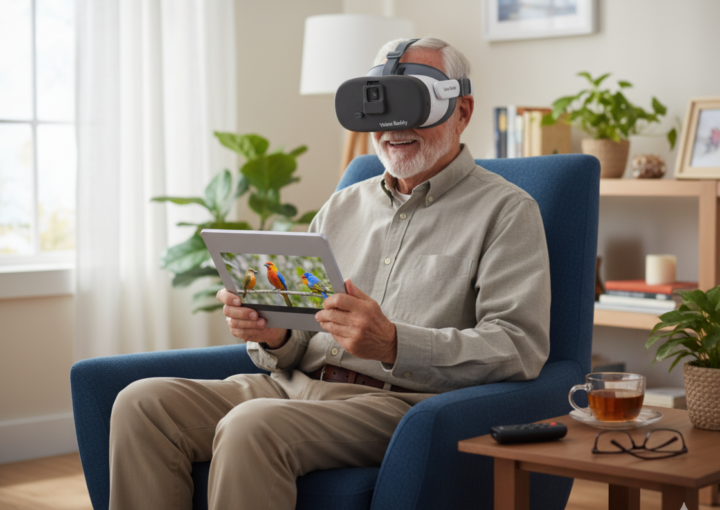
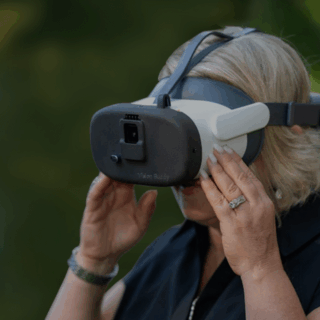
Devices like Vision Buddy are built around exactly the visual functions that matter most for safe movement: real-time magnification, contrast enhancement, and a wide field of view, adjusted to a person’s specific vision profile through the companion app.
Rather than replacing the home safety basics, the right device works alongside them, restoring enough clarity and contrast that a step edge, a doorway, or a piece of furniture is genuinely visible again, not just theoretically there.
This matters most for exactly the everyday, in-between moments that don’t show up in a clinical vision test: walking from a bright kitchen into a dimmer hallway, noticing a pet or a grandchild’s toy on the floor, judging the last step at the bottom of a staircase.
Because there’s no training required and no complicated setup, it’s realistic for someone to actually use a device like this throughout the day, in the moments that matter, rather than only for specific reading or TV tasks.
Frequently Asked Questions
Does low vision really increase fall risk, even if someone can still see reasonably well?
Yes. Research has found that even moderate vision impairment, particularly reduced contrast sensitivity, meaningfully raises fall risk, often before someone would describe their own vision as “bad.”
What’s the single most effective fall-prevention change for someone with low vision?
There isn’t one single fix, the most effective approach combines better lighting and contrast at home with directly addressing the underlying vision loss, rather than relying on home changes alone.
Are certain eye conditions more linked to fall risk than others?
Conditions that reduce peripheral vision or depth perception, like glaucoma and retinitis pigmentosa, carry a particularly high fall-risk profile, since they specifically affect the ability to spot obstacles off to the side or judge distance accurately.
Can assistive technology actually help prevent falls, or is that overselling it?
It’s one real piece of a broader approach. A device that restores magnification and contrast can make everyday hazards, steps, thresholds, dim hallways, genuinely visible again, which directly addresses one of the core mechanisms behind vision-related falls. It’s not a substitute for home safety basics or a current eye exam, but it addresses a piece those steps can’t.
Is Falls Prevention Awareness Week a real, established observance?
Yes. It’s a nationally recognized week, organized around the National Council on Aging’s falls-prevention work, held every September.