Summary
In 2026, people living with low vision have more tools available to them than at any previous point in history. But having more options does not automatically mean better outcomes. This blog takes a practical look at how people with low vision are actually navigating daily tasks like watching TV, reading, and using smartphones in the real world today, what works, what still falls short, and where modern electronic glasses for low vision are filling the gaps.
The Scale of Low Vision Today
Low vision affects hundreds of millions of people globally.
The WHO estimates that approximately 246 million people worldwide have moderate to severe vision impairment, with the vast majority retaining some residual vision rather than experiencing complete blindness.
In the United States alone, roughly 8 million people live with visual impairment that cannot be fully corrected with glasses or contact lenses.
The leading causes include age-related macular degeneration, glaucoma, diabetic retinopathy, and cataracts.
As populations age, these numbers are projected to grow significantly. By 2050, the global prevalence of age-related macular degeneration alone is expected to nearly triple.
These are not distant statistics.
They describe people who want to read the newspaper in the morning, catch a favorite show in the evening, and stay in touch with family through their phones.
The gap between what they want to do and what their visual system currently allows them to do is the central challenge that technology is trying to close.
How People With Low Vision Watch TV in 2026
Television has undergone significant accessibility improvements over the past decade.
Smart TVs now offer built-in magnification for on-screen menus, voice control navigation, audio description compatibility, and high-contrast display modes.
Streaming services have expanded their accessibility features, and a growing percentage of content is available with audio description tracks.
Despite this progress, the fundamental challenge remains: the television is across the room, and vision impairment does not take a break based on how good a platform’s accessibility menu is.
People with low vision report a range of strategies for managing TV watching. Some position themselves much closer to the screen.
Some use screen magnification devices that project part of the TV image onto a secondary display.
Others rely primarily on audio and use visual cues only when something important seems to be happening.
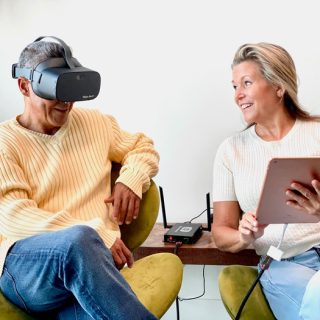
The most significant development in this space in recent years has been the emergence of electronic glasses for low vision that can stream TV content directly to a wearable headset.
Products like Vision Buddy connect to any existing cable box or streaming provider via a TV Hub, then transmit the feed wirelessly in high definition to a headset worn by the user.
The result is a close-up, magnified, adjustable image that travels with the viewer’s gaze.
This approach solves the distance problem entirely. The viewer can sit wherever is comfortable, lie down if they prefer, and still receive a crisp, magnified feed.
For people with macular degeneration or other central vision loss, having the image delivered at adjustable magnification directly to the eye bypasses the limitations of their natural visual processing in a way that simply making the TV bigger never could.
Reading in 2026: From Magnifiers to AI-Powered Text Enhancement
Reading is one of the activities most affected by low vision, and one where technology has made significant strides.
The range of reading aids available in 2026 spans from simple optical magnifiers to sophisticated AI-powered text recognition systems.
At the basic end, high-powered reading glasses and handheld optical magnifiers remain widely used.
They are low cost, require no batteries or setup, and are often effective for brief reading tasks like checking a price tag or reading a phone number.
For longer reading sessions, desktop CCTV magnifiers have been a workhorse technology for decades.
These devices use a camera pointed at a reading surface and display an enlarged image on a monitor. Modern versions offer adjustable magnification, contrast enhancement, and color filter options.
They are effective but large, stationary, and expensive.
Screen readers and text-to-speech software have become increasingly capable and accessible, particularly on smartphones and computers.
These tools convert digital text into spoken audio, allowing users to consume written content without relying on their vision at all.
For many people with severe vision loss, screen readers have become essential daily tools.
The frontier in 2026 is AI-powered reading assistance.
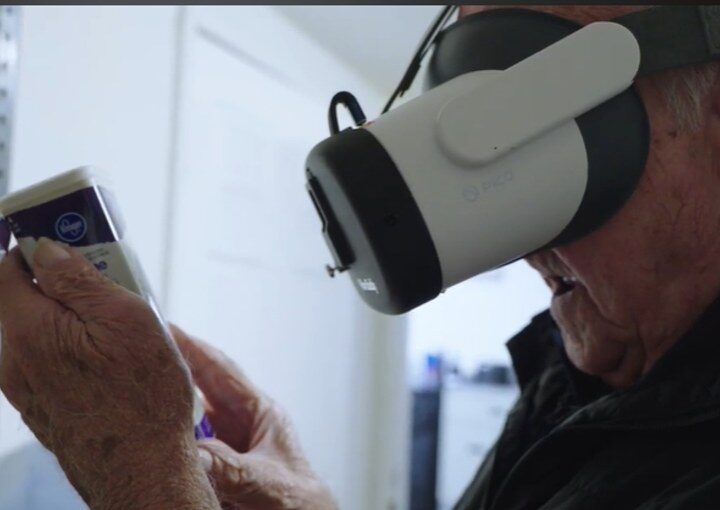
Modern electronic glasses for low vision like Vision Buddy incorporate optical character recognition (OCR) technology that can identify text in the environment, not just on screens, and display it in enhanced, magnified form.
This means a user can pick up a physical book, hold a medication bottle, or look at a restaurant menu and receive real-time text enhancement directly in their field of view.
The Vision Buddy system pairs its wearable headset with a CCTV Mini camera for enhanced desktop reading.
This means users can work at a desk, review documents, check mail, and read books using the same device they use for TV watching, with a seamless switch between modes.
Smartphones and Low Vision: Accessibility Progress and Real-World Gaps
Smartphones have become one of the most important accessibility platforms for people with visual impairments.
Both Apple and Android have invested heavily in built-in accessibility features, and the results are genuinely impressive.
iOS offers VoiceOver (a comprehensive screen reader), Zoom (a full-screen magnifier), Display Accommodations (color filters, reduced white point, increased contrast), and Speak Screen.
Android offers TalkBack, Magnification, and a growing suite of accessibility settings. Both platforms have made these features significantly easier to configure and use in recent years.
Third-party apps have also expanded the accessibility toolkit considerably.
Magnifier apps, high-contrast keyboard apps, audio description apps for identifying objects and currency, and AI-powered scene description tools are all available on both platforms.
Despite this progress, people with low vision report real frustrations with smartphone use.
App developers do not always follow accessibility guidelines, leaving some apps essentially unusable with screen readers.
Small tap targets, low-contrast text, and reliance on visual-only cues remain common problems across many popular apps. Notification management is particularly challenging for users who rely on audio feedback.
There is also the physical challenge of holding and looking at a small screen.
For people with tremors, which are more common in older adults who also tend to have higher rates of low vision conditions, smartphone use requires significant effort and concentration.
Electronic glasses for low vision address some of these challenges directly.
Vision Buddy includes a Computer Link feature that allows users to connect the headset to their PC or mobile device and view the screen in a magnified, enhanced format within the headset display.
This effectively transforms any screen into a personal magnified display.
The Rise of Wearable Low Vision Aids
The most significant trend in low vision assistive technology in the past several years has been the move toward wearable, all-in-one solutions.
The appeal is obvious: instead of having separate devices for TV watching, reading, computer use, and distance viewing, a single wearable device can handle all of these scenarios.
Modern electronic glasses for low vision like Vision Buddy represent the current state of the art in this category.
The Vision Buddy 4 Max, for example, includes a Sony high-resolution AI camera with 16-megapixel optics, a 4K per-eye display, up to 10x adjustable magnification, a 98-degree field of view, and a dedicated TV Hub for wireless TV streaming.
The device weighs approximately 1.1 pounds and includes an external battery that extends use to around 6 hours.
The companion VB app, co-created with optometrists, allows users to personalize their visual experience by adjusting contrast, brightness, color filters, and reading modes.
The simplicity of the setup is a significant selling point.
Vision Buddy is designed to require no training, an important consideration for older users or those who are not comfortable with complex technology. Plug in the TV Hub, put on the headset, and start watching.
The learning curve is intentionally minimal.
How Vision Buddy Addresses All Three Activities in One Device
One of the most compelling aspects of Vision Buddy as a low vision aid is its ability to address TV watching, reading, and digital device use within a single integrated system.
For TV watching, the TV Hub connects to any cable box or streaming device and transmits the feed wirelessly to the headset in 1080p or higher quality.
Users can watch from any position in the room, adjust the image to their visual needs, and follow the action with clarity that is simply not achievable by sitting closer to a standard screen.
For reading, the combination of the Sony AI camera and the CCTV Mini provides real-time text magnification and enhancement for both physical documents and books.
The OCR capability means the device does not just make text larger; it can actively enhance clarity and contrast in ways that compensate for specific patterns of vision loss.
For computer and smartphone use, the Computer Link feature extends the headset’s display capabilities to external screens.
This means users are not managing separate reading glasses for computer work and a separate device for TV. One device handles the full range of daily visual tasks.
What the Research Says About Independence and Quality of Life
Research consistently shows that low vision rehabilitation and assistive technology have meaningful positive effects on quality of life.
Studies published in journals including Ophthalmology and the British Journal of Visual Impairment have documented improvements in activity participation, social engagement, and mental health outcomes following low vision rehabilitation.
The ability to perform daily tasks independently, including watching TV, reading mail, and using a phone, is a significant predictor of wellbeing among older adults with visual impairment.
Technologies that preserve or restore this independence have effects that extend well beyond visual function.
Depression rates among people with low vision are significantly higher than in the general population, with some studies estimating rates two to three times higher.
This is not primarily because of visual limitation per se, but because of the downstream effects on participation, independence, and social connection.
Electronic glasses for low vision that restore meaningful participation in daily activities address these downstream effects directly.
Looking Ahead
The trajectory of low vision assistive technology is toward greater intelligence, greater integration, and greater accessibility.
AI capabilities in devices like Vision Buddy are expanding rapidly, with improvements in scene recognition, real-time object identification, and adaptive display adjustment being active areas of development.
For people living with low vision today, the practical message is this: the gap between what low vision allows and what you want to be able to do is narrower than it has ever been.
Tools like Vision Buddy exist precisely to close that gap for everyday activities like watching TV, reading, and using your phone.
If you have been managing workarounds, it may be time to explore what a purpose-built electronic glasses for low vision solution can actually do for your daily life.