

Summary
September is National Guide Dog Month, a good moment to recognize the extraordinary work guide dogs and their handlers do together, and also to talk honestly about where other kinds of assistive technology fit into the same picture. Guide dogs and AI wearable devices like Vision Buddy aren’t competing solutions to the same problem, they address genuinely different needs.
This guide walks through what each one actually does, where they overlap, and why for many people with low vision, the most independence comes from having access to both, not from choosing one over the other.
Two Very Different Kinds of Help
It’s easy to lump “assistive technology for the blind” into one category, but a guide dog and a pair of AI-powered wearable glasses solve genuinely different problems.
A guide dog is trained to help with safe, confident mobility, navigating streets, avoiding obstacles, stopping at curbs and stairs. An AI wearable device like Vision Buddy is built around visual tasks, reading, recognizing faces and objects, watching television, using a computer.
Neither one is a smaller or lesser version of the other, they’re built for different moments in a day.
Understanding that distinction matters, because the real question usually isn’t “which one is better,” it’s “which specific everyday tasks does someone need help with, and what actually addresses each one.”
What a Guide Dog Actually Does
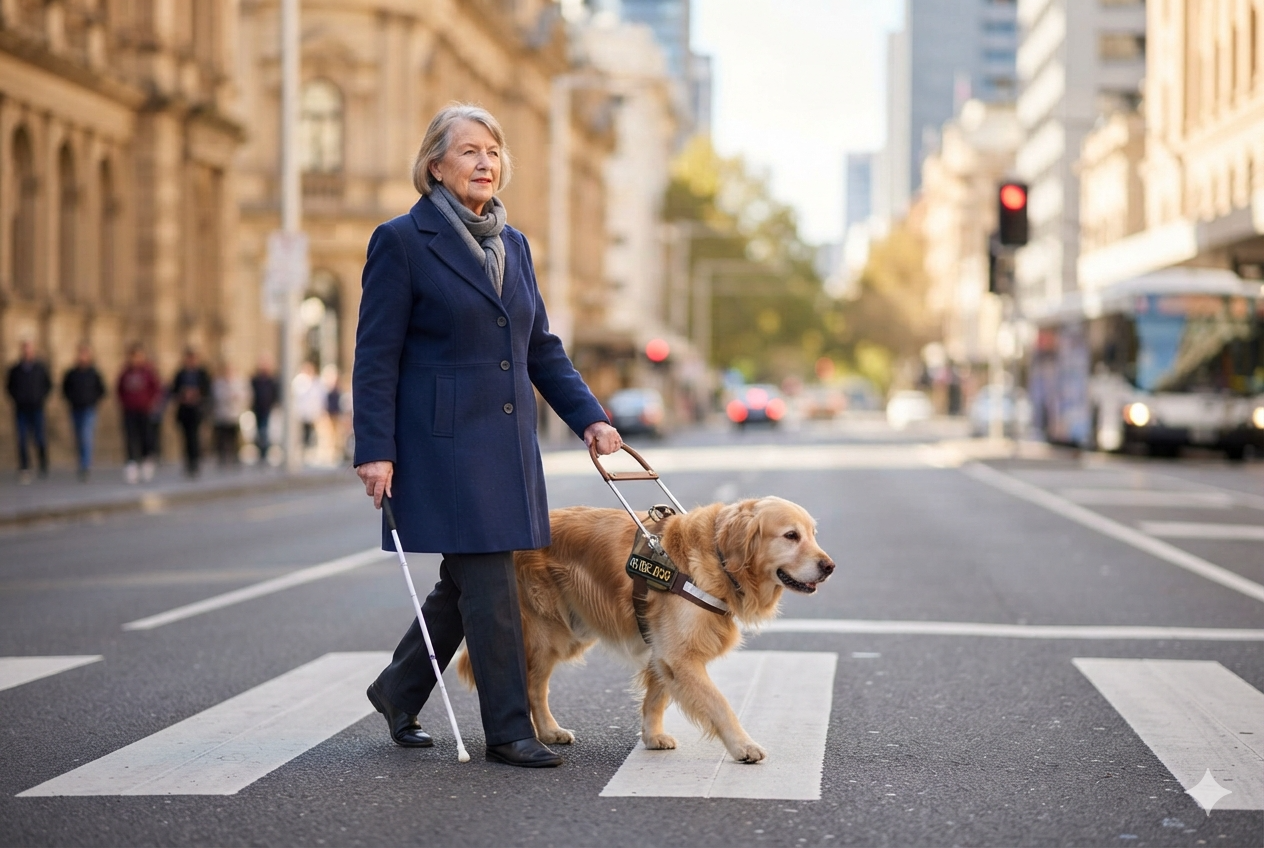
Guide dogs go through extensive professional training, typically over many months, to safely lead a handler through complex, unpredictable environments: city streets, crowded spaces, stairs, public transit.
They’re trained to stop at curbs and obstacles, navigate around hazards, and, notably, to exercise what trainers call “intelligent disobedience,” refusing a command if following it would actually be unsafe, like stepping into oncoming traffic.
That combination of trust, training, and judgment is something no piece of technology replicates.
A guide dog’s real strength is mobility and safety in motion, getting from one place to another confidently and safely, especially in environments that are unfamiliar or constantly changing.
What AI Wearable Technology Actually Does
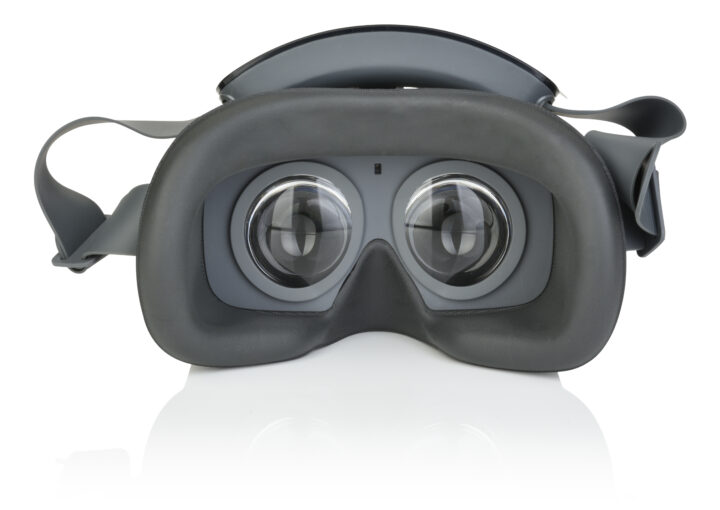
A device like Vision Buddy is built around a different set of needs entirely: real-time magnification, contrast enhancement, and features like OCR text reading and face and object recognition, tasks that depend on seeing detail clearly rather than navigating physical space.
It helps someone read a menu, recognize a familiar face across a room, watch television comfortably, or work at a computer, activities a guide dog’s training doesn’t address at all, because that was never the goal.
Where a guide dog helps someone move safely through the world, an AI wearable device helps someone see the world more clearly once they’re in it, reading, recognizing, watching, working.
Where the Two Genuinely Overlap, and Where They Don’t
There’s a small area of real overlap: both can contribute to a person’s overall confidence and independence moving through daily life, and both reduce reliance on another person for specific everyday tasks. But the actual mechanisms don’t overlap much at all.
A guide dog doesn’t help someone read a prescription label. An AI wearable device doesn’t navigate a busy intersection or stop at a curb.
That’s exactly why framing them as competing options misses the point. They solve different problems, and for a lot of people, the honest answer to “which one do I need” is genuinely both, depending on the specific challenges vision loss creates for that person.
Why Many People Benefit From Both
Someone who is fully blind or has very severe vision loss and relies on a guide dog for safe, independent mobility may still benefit enormously from a wearable device for reading mail, recognizing a grandchild’s face, or watching a favorite show, tasks a guide dog was never meant to help with.
Conversely, someone using an AI wearable device for magnification and reading might also benefit from a guide dog, a cane, or another mobility aid if navigation and safe movement through unfamiliar spaces is a separate, real challenge.
The two aren’t in competition for the same role in someone’s life.
A thoughtful approach to independent living with vision loss usually means matching the right tool to the right task, not picking a single solution and expecting it to cover everything.
Choosing What’s Right for a Specific Situation
A few honest questions help clarify what actually matters most for a given person:
- Is the bigger day-to-day challenge mobility and navigation, or specific visual tasks like reading and recognizing people? The answer often points clearly toward one type of support or the other, or both.
- What does a typical day actually involve? Someone who spends most of their time at home reading, watching TV, and using a computer has different needs than someone navigating a city commute daily.
- What’s already working, and what specific moments still feel hard? The clearest signal for what kind of help is missing usually comes from naming the actual moments that don’t work well right now.
A conversation with an orientation and mobility specialist, a low vision specialist, or both, is the most reliable way to sort through these questions for a specific person’s situation, rather than assuming one type of support should replace the other.
Frequently Asked Questions
Is a guide dog “better” than assistive technology like AI glasses?
Neither is better, they do different jobs. A guide dog helps with safe, confident mobility. AI wearable technology helps with visual tasks like reading, recognizing faces, and watching TV. Many people genuinely benefit from both.
Can someone with a guide dog also use a device like Vision Buddy?
Yes. There’s no conflict between the two, a guide dog handles mobility and navigation, while a wearable device addresses reading, recognition, and screen-based tasks a guide dog’s training was never meant to cover.
How long does it typically take to get a guide dog?
Timelines vary significantly by organization, including waitlists and training requirements, and are best confirmed directly with a specific accredited guide dog school rather than generalized here.
Does using assistive technology mean someone doesn’t need a guide dog, or vice versa?
No. The right combination depends entirely on a person’s specific vision loss, lifestyle, and daily challenges, not on picking one category of support and ruling out the other.
Where can I learn more about guide dog programs specifically?
Accredited, nonprofit guide dog schools are the right source for program details, costs, training timelines, and eligibility, since these vary by organization and change over time.