


Summary
Watching TV with a visual impairment is a deeply personal challenge that millions of people navigate every single day. This blog explores what the experience is actually like, the workarounds people have relied on for years, and why modern electronic glasses for the visually impaired are changing what is possible. Whether you have macular degeneration, glaucoma, or another condition affecting your sight, there are now more options than ever to enjoy your favorite shows with independence and clarity.
Why TV Watching Is Harder Than It Sounds
For most people, turning on the TV and settling into the sofa is the most effortless thing in the world.
For someone living with low vision, that same simple act can feel like navigating an obstacle course.
Consider what watching TV actually requires: reading on-screen text like subtitles, menus, and news tickers; distinguishing faces and expressions from across a room; following fast-paced action sequences; and managing glare on large, bright screens.
Each of these tasks can become genuinely exhausting or impossible when your central vision is compromised, your contrast sensitivity has dropped, or your field of view has narrowed.
Low vision is not the same as complete blindness.
According to the World Health Organization, low vision is defined as a visual acuity worse than 6/18 but equal to or better than 3/60, or a visual field of less than 20 degrees, in the better eye with the best possible correction.
That means most people living with low vision retain some functional sight, but not enough to watch TV comfortably the traditional way.
Conditions like macular degeneration destroy the central field of vision, which is the part you use to read and watch faces. Glaucoma attacks peripheral vision, narrowing what you can see over time.
Diabetic retinopathy can cause unpredictable blurring across different parts of the visual field. These are not minor inconveniences. They fundamentally reshape how a person experiences every visual activity, including something as everyday as catching the evening news.
The Traditional Workarounds People With Low Vision Have Used
Before electronic glasses for the visually impaired existed, people made do with a range of creative and often exhausting workarounds.
Sitting Much Closer to the Screen: Many people with low vision would push their chairs right up to the television set. This works to some degree, but it is hard on the neck, creates a narrow field of view, and is not always practical in shared living situations.
Getting Larger TVs: Bigger screens mean bigger images. But there is a limit to how large a practical home television can be, and larger screens also mean more glare and more visual noise.
Increasing Screen Brightness: Cranking the brightness can help some people with certain types of low vision, while making things worse for others. People with light sensitivity, which is common with some retinal conditions, find bright screens actively uncomfortable.
Using Handheld Magnifiers: Holding up a magnifier to watch TV is as awkward as it sounds. It limits mobility, causes arm fatigue quickly, and is only effective for very small areas of the screen at a time.
High-Contrast Settings: Some televisions allow you to adjust color contrast and sharpness. These settings help some viewers but cannot compensate for significant vision loss.
The honest truth is that these approaches are patches rather than solutions. They require significant effort and planning for what should be a relaxing activity, and they still leave most people with low vision unable to fully enjoy the experience.
How Audio Description Helps (and Where It Falls Short)
Audio description is one of the more meaningful accessibility developments for TV viewers with low vision.
It works by adding a narrated track to broadcasts and streaming content that describes visual elements: what a character is wearing, where a scene is taking place, key action that is not covered by dialogue.
Major streaming platforms like Netflix, Amazon Prime Video, Apple TV Plus, and Disney Plus have expanded their audio description libraries significantly in recent years.
The BBC in the UK has mandated audio description on a large portion of its programming. In the United States, the FCC has requirements for audio description on major broadcast networks.
Audio description is a genuine improvement for people with more severe vision loss or complete blindness.
But for people who retain some functional vision and are watching with low vision aids, it creates a different kind of experience.
You are no longer watching a show. You are listening to it being narrated to you.
That is not the same thing.
Watching faces react, following background action, seeing the beauty of a landscape shot, noticing the humor in a visual gag, these things cannot be fully replaced by narration.
Most people with low vision want to see the show, not just hear about it.
The Accessibility Gap Nobody Talks About
There is a significant gap in public understanding about what low vision actually means in practice. It is not just difficulty reading small text or seeing in dim light.
It is the cumulative loss of the visual activities that make life rich and connected, activities like recognizing a loved one’s face on screen, laughing along with a comedy because you could actually see the physical humor, or following an intense sports match in real time.
The social dimension of this loss is significant too. In many households, watching TV is a shared activity.
It is how families and friends spend time together, how people stay connected to cultural conversations, how people relax and bond.
When someone cannot fully participate in that experience, there is a quiet but real sense of isolation.
Many people with low vision also report adjusting their viewing habits significantly, avoiding certain types of content, watching primarily shows they have already seen, relying on partners or family members to describe what is happening on screen.
These are not choices people make because they prefer it. They make them because the alternatives are limited.
How Electronic Glasses for the Visually Impaired Are Changing the Game
This is where technology has genuinely changed what is possible.
Electronic glasses for the visually impaired, particularly modern AI-powered devices like Vision Buddy, represent a fundamentally different approach to the problem.
Rather than asking someone to move closer to a screen or rely on external narration, these devices bring the visual content directly to the viewer’s eyes with enhanced clarity, magnification, and adjustable settings tailored to their specific vision profile.
Vision Buddy, for example, includes a dedicated TV Hub system that connects directly to any cable box or streaming provider.
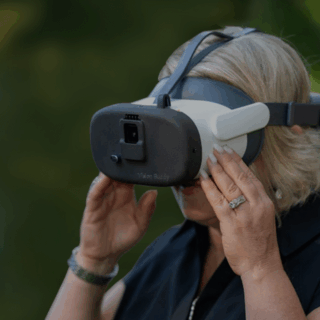
The TV signal is wirelessly transmitted in high definition to the headset, where the built-in 4K display and Sony AI camera work together to present the viewer with a magnified, contrast-enhanced, personalized image.
You can adjust brightness, contrast, and reading filters on the fly through the companion app.
This means someone with macular degeneration can watch their favorite show in a comfortable chair, at a normal distance, with a clear and magnified image delivered right to their eyes.
They are not leaning forward, straining, or relying on someone else to tell them what is happening. They are watching.
The difference in lived experience between those two situations is hard to overstate. One is watching TV. The other is surviving a version of it.
What Real Users Say About Watching TV With Low Vision Glasses
People who have used Vision Buddy describe the experience in remarkably consistent terms: the feeling of getting something back that they thought was gone.
One user shared that she can now watch TV lying down, follow the plot of shows without needing to ask her family what is happening on screen, and read medication labels while wearing the device.
Another user described it as overwhelming in the best sense: having lost their vision many years earlier, seeing clearly through a wearable device felt like a life-changing moment.
These testimonials are consistent with the broader research on quality of life for people with low vision.
Studies have shown that loss of visual function is strongly associated with depression, social isolation, and reduced independence.
Technologies that restore functional vision, even partially, have measurable positive effects on mental health and wellbeing.
Practical Tips for Better TV Watching With Low Vision
Whether or not you are using electronic glasses for the visually impaired, there are practical steps that can improve the experience.
Optimize Your Viewing Environment: Reduce ambient light to minimize screen glare. Position yourself so that windows are not behind the screen. Consider blackout curtains in your TV room.
Use Your TV’s Built-In Accessibility Features: Most modern smart TVs have visual accessibility settings. These include high contrast modes, text enlargement for on-screen menus, and color correction filters.
Enable Audio Description as a Supplement: Even if you are using visual aids, having audio description running in the background can fill in the gaps during complex visual scenes.
Consider a Dedicated Low Vision Setup: If you watch TV frequently, it is worth investing in a purpose-built solution rather than cobbling together multiple workarounds. Devices like Vision Buddy are specifically engineered for this use case.
Talk to a Low Vision Specialist: An optometrist or ophthalmologist who specializes in low vision rehabilitation can assess your specific situation and recommend appropriate aids.
Final Thoughts
Watching TV with a visual impairment is genuinely hard. The solutions that existed for decades required significant compromise and still left people at a disadvantage. That landscape has changed.
Electronic glasses for the visually impaired, and Vision Buddy in particular, offer something that the old workarounds never could: the real experience of watching, not a modified, narrated, or approximated version of it.
If you or someone you love has been quietly adapting their TV habits around a vision impairment, it is worth knowing that real solutions exist today.
Because watching your favorite show should feel like watching your favorite show, not like work.


